What are bacteria?

Bacteria are microscopic living organisms consisting of a single cell. Millions (if not billions) of different bacterial species exist all over the world, including within the human body. They are found on the skin, in the respiratory tract, and in the mouth. They are also present in the digestive system, reproductive system, and urinary tract.
Most types of bacteria are not harmful. Some are even beneficial. These useful bacteria are mainly found on the skin or in the intestines/digestive system. They are referred to as resident flora, or the microbiome (groups of microorganisms living in and on the human body).
Most bacteria are harmless, but certain species can make you ill. These bacteria are a type of pathogen that can multiply rapidly in your body and release toxins that may cause infections.
What is Biofilm?
A biofilm is a layer of bacteria or other microorganisms that grows on and attaches to the surface of a structure. Biofilms can cover natural surfaces such as teeth and other parts of the human body, as well as material surfaces in our environment.
Bacteria biofilms are clusters of bacteria that adhere to surfaces and to each other, embedded in a self-produced matrix. Under the right conditions, biofilms can grow by up to one centimetre per day!
Detection of bacteria and biofilms
Biofilms and bacteria represent an invisible risk in any hygiene-sensitive environment, such as the food and beverage industry, healthcare, mould control, and even the nuclear energy sector. The physical detection of bacteria and biofilms is mainly carried out using ATP measurements, where a sample is taken with a swab and subsequently analysed. The disadvantage of ATP testing is that only the swabbed surface is analysed, making the detection of larger surfaces a costly and time-consuming process.
When organic material such as bacteria and fungi is visible, there is a high likelihood of contamination. Swab testing usually confirms this; however, microbial contamination is often not visible to the naked eye. As a result, it is not always clear where a swab sample should be taken. This can lead to broad, non-specific testing, which is time-consuming and costly, and may still fail to identify the root cause of the problem.
With the Bioglo detection lamp, invisible bacterial contamination such as biofilms can be made visible on larger surfaces within seconds. This advanced inspection lamp is specifically designed for quality control in hygiene-sensitive environments such as food processing, pharmaceuticals, and sanitary inspections.
Real-time visibility of bacteria, fungi, product residues and other contaminants
Although UV-A light and standard blacklights both fall within the ultraviolet spectrum, there are important differences in operation and effectiveness, particularly when it comes to detecting bacteria and biofilms.
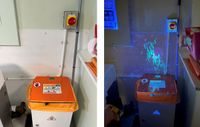
The Bioglo detection lamp is equipped with 12 ultraviolet (UV) light sources that continuously pulse across different UV wavelengths. This combination of specific UV wavelengths induces broad-spectrum luminescence in the protein layer of microorganisms. Molecules within the protein envelope become excited by the UV light and emit visible fluorescence. With its patented technology, the Bioglo detection lamp makes microorganisms visible to the naked eye, regardless of whether the contamination is alive or dead.
Standard UV lamps and blacklights emit a single specific UV wavelength. Certain fluorescent substances absorb ultraviolet light and re-emit it at a different wavelength, making the light visible and causing the material to appear to glow.
What you see glowing under a blacklight are phosphors. Bodily fluids such as blood and urine contain these fluorescent molecules and can be made visible using a blacklight. Blacklight can also be used to detect counterfeit banknotes that lack the fluorescent security features found on genuine currency.
Common materials that fluoresce under blacklight include:
- White paper treated with fluorescent compounds to appear brighter and “whiter”
- Quinine, the bitter flavouring in tonic water, which glows blue-white under UV light
- Optical brighteners in laundry detergents that make clothing appear “whiter than white”
- Fluorescent ink pens
- Vaseline
Why choose the Bioglo detection lamp?
- Real-time detection of bacteria, biofilms, fungi, product residues and many other contaminants
- Quickly and easily inspect large surface areas
- Supports easier monitoring of hygiene standards
- Reduces unplanned downtime or production stoppages
- Environmentally friendly, non-invasive and safe to handle/use
- Cost savings by making other testing methods, such as ATP swab tests, more targeted and efficient
Ease of use – Bioglo detection lamp
- Handheld, robust and portable
- Safe and simple to operate
- No special equipment or training required
- IP65-rated
- USB-C rechargable




 EN
EN NL
NL